How the Industrial Metaverse is revolutionizing factory design by seamlessly integrating the submodels of different software systems and creating unprecedented transparency.
The Industrial Metaverse is transforming factory design by seamlessly integrating the sub-models of various software systems, creating a level of transparency previously unmatched. It supports the entire lifecycle of a factory, enabling holistic and active lifecycle management in the process. At the same time, the Industrial Metaverse presents companies with challenges: they must quickly integrate these new technologies into their IT infrastructure and processes to remain competitive. This makes it all the more important for us to take a closer look and provide answers to ten key questions.
1. What is the Industrial Metaverse?
The Industrial Metaverse is a virtually connected environment that digitally represents real-world industrial processes and equipment. It serves as a technology platform integrated with expert tools, enabling it to jointly model both the static and dynamic aspects of a digital twin. Looking ahead, connections to data spaces such as Gaia-X and Catena-X are also conceivable.
2. How are Building Information Modeling and Industrial Metaverse Related to Each Other?
The concept of Building Information Modeling (BIM) originated in the construction sector but is now also applied in production system planning. During a project, digital twins may be created; however, they typically represent only static parameters such as geometries and characteristics. BIM therefore serves as a potential data source for the Industrial Metaverse.
3. What is the Difference Between the Industrial Metaverse and a Digital Twin?
The distinction is reflected in how they are represented in the digital space. A digital twin is a virtual, real-time model of an individual physical object, such as a machine or a building, and encompasses both static and dynamic parameters. By contrast, the Industrial Metaverse represents a superordinate technological level. As a platform, it can, for example, interconnect multiple digital twins with one another.

5. How Does the Industrial Metaverse Support Factory Planning?
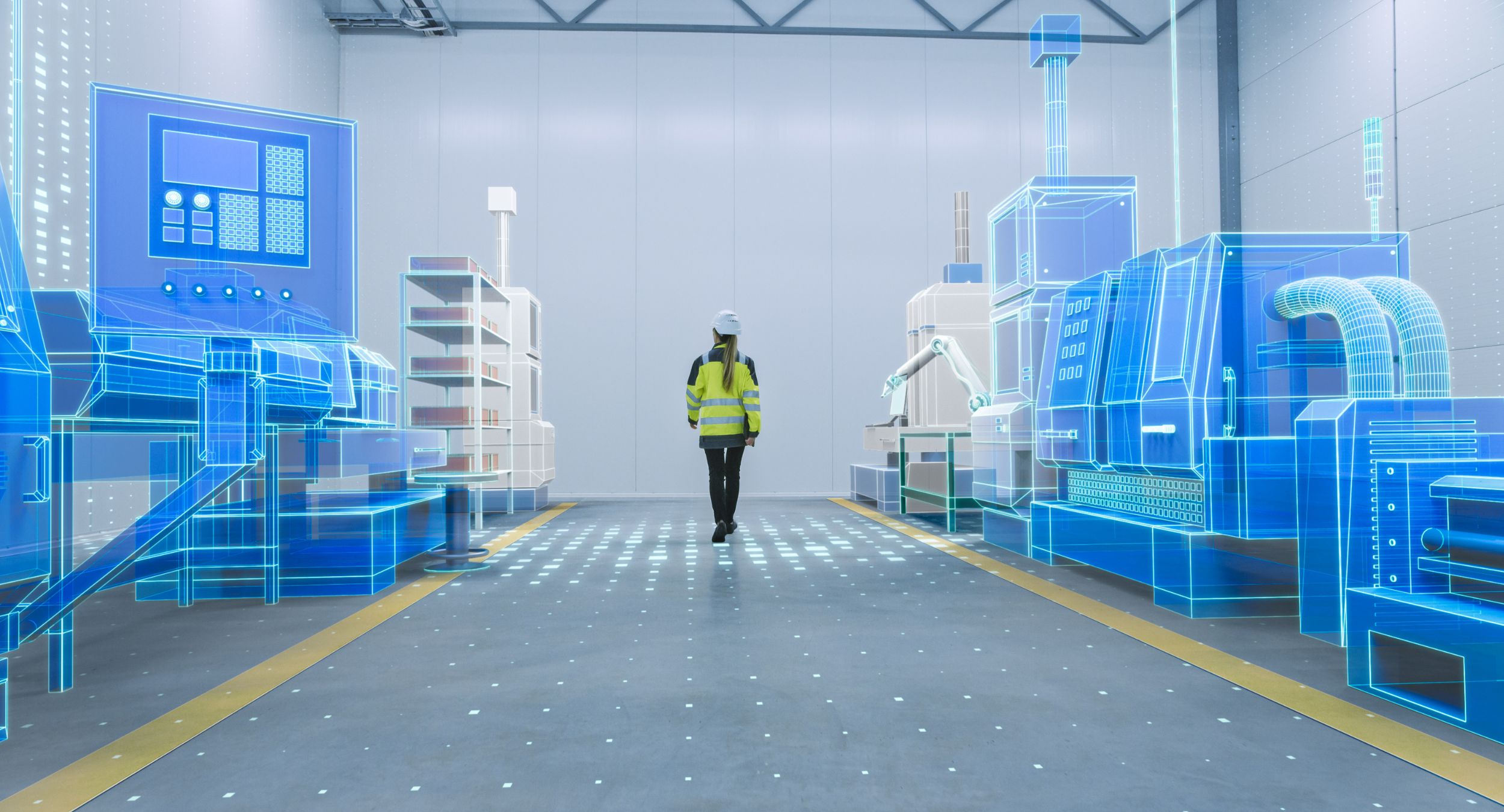
The Industrial Metaverse connects previously isolated software applications and 3D models, enabling their interoperable migration through a unified exchange format. In addition, it supports a new, more accessible form of collaboration through simulations, virtual facility visits, and inspections enabled by immersive mixed reality applications.
6. How is the Industrial Metaverse Used in Factory Planning?
The Industrial Metaverse establishes a new connection between the planning process and factory operations. Design plans and models can be seamlessly transferred into day-to-day operations, virtual tests and launches can be integrated, and predictive maintenance processes can be implemented. Even site-independent expert support using mixed reality becomes possible.
7. What are the Technical Prerequisites for Industrial Metaverse Applications?
In terms of hardware, the Industrial Metaverse requires powerful computing systems and end devices, as well as sensors and IoT systems. From a software perspective, modeling, simulation, and collaboration applications are essential, along with the corresponding servers and databases. In addition, fast and stable internet connectivity is crucial.
8. Which Industries and Companies are Leaders in Terms of the Industrial Metaverse?
Several technology providers, including Nvidia, Siemens, and Microsoft, have incorporated Metaverse platforms and applications into their portfolios. On the user side, the automotive sector is particularly pioneering, with companies such as BMW, Audi, and Mercedes launching pilot projects.
9. How and in What Ways is the Industrial Metaverse Already Being Used in Factory Planning Today?
Numerous manufacturing companies are already leveraging Industrial Metaverse applications to support virtual factory planning. Their primary goal is to improve the efficiency of data exchange between planning tools. In addition, the adoption of open system standards is steadily increasing, reinforcing the Industrial Metaverse’s role as an open technology platform.
10. What Does the Adoption of the Industrial Metaverse Mean for Employees?
The Industrial Metaverse will transform many work processes in factory and system planning. While the fundamental skill requirements will remain the same, the way they are applied will change. Manual tasks will increasingly be handled by AI, and employees will shift from directly performing tasks to managing and controlling the systems that shape them.
Our team is ready to support you in developing customized Industrial Metaverse solutions across all aspects of your factory: design, planning, and operation.